Our Story – Event Logistics Reimagined
The History of Cargo Cart
Our company history at Cargo Cart emerged step by step from the real-world requirements of event and logistics practice. Many of the ideas came directly from daily work in the event industry.
The timeline shows how a modular logistics system developed over the years from initial concepts and prototypes, which is now used in events, trade fair construction, and production. Each stage represents specific further developments and improvements to the system.
The result is a solution that was not planned at a desk, but developed directly from the requirements and experiences of the field.
2002
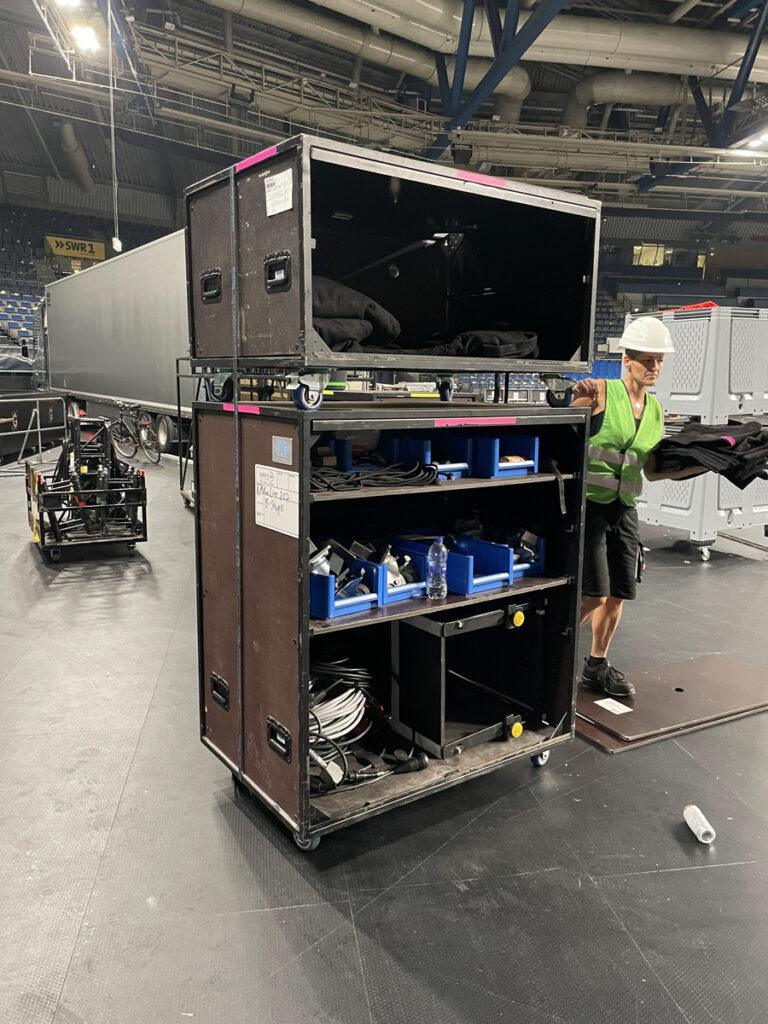
Event logistics is stuck in the flight case era. Heavy, inflexible, and bad for your back. Somewhere in the Ruhr area, a thought emerges: there must be a better way. This drives Ingo to his desk at night.
The first ideas for Cargo Cart are born.
2004
Sleepless nights, poor workflows, heavy cases, and frustrated loading teams. Instead of continuing to complain, Ingo is driven to his desk at night. Sketches are made, tests are run, and everything is questioned.
Goal: escape the logistics chaos.
2005
Loading flight cases and Euro pallets feels like a bad game with too many wrong pieces.
The idea: a system that finally makes sense and protects the body. Ingo tinkers with a system featuring uniform external dimensions and a maximally flexible interior. No more daily games of Tetris when loading trucks.
2006
The first concepts take shape. The goal: less heavy lifting, more logic, more ergonomic work, and an end to the constant tipping of heavy cases. Back pain doesn't find it funny at all.
2007
The first prototype is created. Between tools, night shifts, and plenty of sawdust, the new system finally gets its name: Cargo Cart.
2008
The first Cargo Cart sees the light of day. Large, striking, and somehow different. Still eyed with skepticism, but with plenty of potential for the future of event and production logistics.
2009
The industry takes notice. For the first time, Cargo Cart shows that logistics can also be simpler, more flexible, and gentler on materials. The Euro pallet gets some competition.
And Cargo Cart continues to evolve: open steel frames instead of rigid walls. More flexibility, better protection, and new possibilities for trade fair and event logistics.
2010
With Cargo Carts, the company officially declares war on flight cases and pallets, saying "goodbye" to pallets and flight cases as the standard solution in event logistics.
The patent is filed, and the Cargo Cart company history really picks up speed.
2015
The Cargo Cart community grows, and with it, the product range. New accessories ensure even more modularity for mobile transport solutions in event logistics. Feedback from the field remains the most important driver.
And Cargo Cart moves. Just 23 meters further, but with significantly more space, its own production line, and professional warehouse management.
2018
Cargo Cart establishes itself more and more in the industry. While flight cases and pallets are starting to break a sweat, Ingo is already working on the next expansion stage of the system. Sleep is overrated.
The time has come: the Cart product family is growing. New Cargo Cart models expand the system and make event logistics even more flexible, efficient, and professional. And the industry is increasingly noticing that something fundamental is changing here.
2021
COVID-19 may have stopped the industry, but not the development. In the meantime, Cargo Cart continued to build, improve, and rethink.
The first events return, and with them, the demand for flexible event logistics.
Cargo Cart becomes more modular, more durable, and stronger than ever. Despite the lockdown, the phones are ringing off the hook, and the Cargo Cart company history writes its next chapter.

2022
Events are getting bigger, crews are getting smaller, and the pressure is high. That is exactly what Cargo Cart is for.
Our mobile transport systems ensure faster loading, less heavy lifting, and significantly more relaxed workflows in event logistics.